
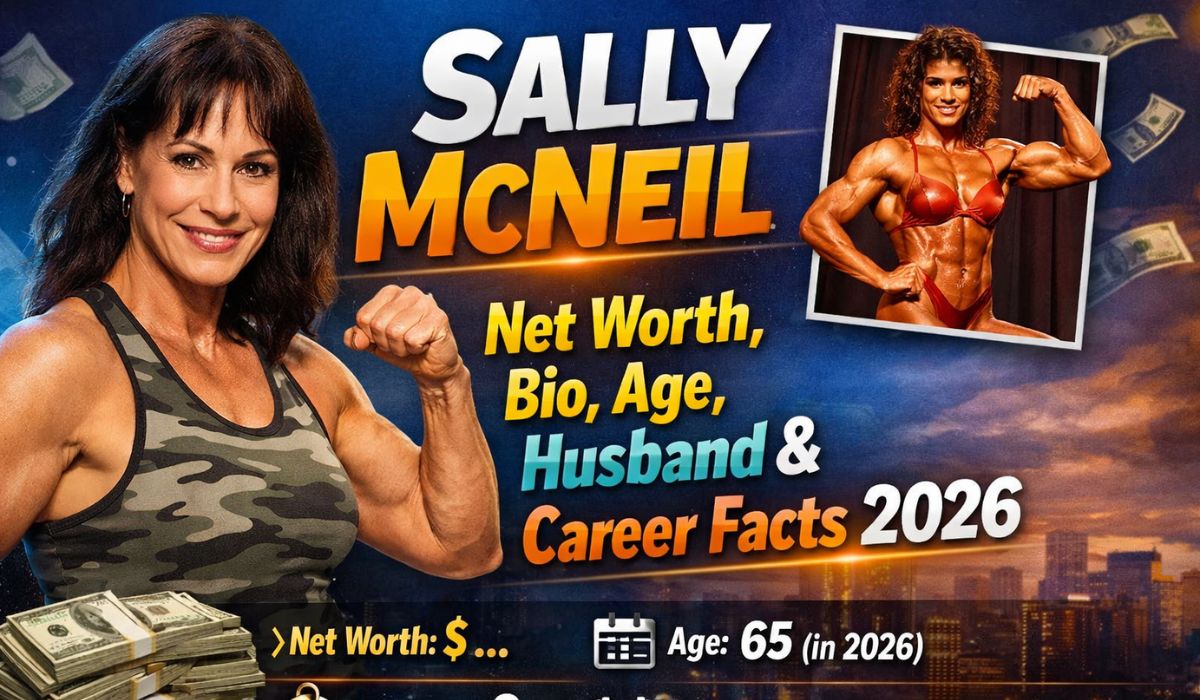

Sally McNeil Net Worth, Bio, Age, Husband & Career Facts 2026 explores the complex life story of Sally McNeil, a former American bodybuilder whose name became widely known through both her athletic career and the dramatic events that followed it. The article takes a closer look at her early life, competitive bodybuilding achievements, and how she gained recognition in the fitness world. It also examines her personal life, including her relationship with her husband Ray McNeil and the circumstances that later brought her story into national headlines.
Readers will also discover details about Sally McNeil’s net worth in 2026, her age, biography, and the major turning points that shaped her life. The piece explains her time in the military, her career in professional bodybuilding, and how documentaries and media coverage revived public interest in her story decades later. By combining factual information with historical context, the article gives a clear overview of Sally McNeil’s life, career milestones, and the lasting impact of her story.
Who Is Sally McNeil?
Sally Anne McNeil is a former Marine sergeant, professional bodybuilder, and one of the most controversial figures in the history of female bodybuilding in the United States. Long before true crime fans discovered her story on Netflix, she was turning heads on competition stages across America with a muscular physique that challenged every existing notion of what a woman’s body could look like. Her nickname — Killer Sally — was a badge of honor in the gym long before it became a headline in a courtroom.
She built her identity around toughness. The U.S. Marine Corps shaped her discipline, competitive bodybuilding sharpened her focus, and sheer personal willpower carried her through circumstances that would have broken most people. But the 1995 homicide of her husband Ray McNeil — a fellow bodybuilder spouse — changed everything in a single night. The high-profile case consumed her life for the next 25 years. Released from prison in 2020, she stepped back into a world that had almost forgotten her — until Netflix reminded everyone.
This article covers everything: her earnings, income sources, wealth accumulation journey, competitive bodybuilding career, military service, personal relationships, and what Sally McNeil’s net worth actually looks like in 2026.
Sally McNeil Biography
Sally Anne McNeil didn’t arrive on the bodybuilding scene with a silver spoon or a wealthy sponsor. She clawed her way there through grit, sweat, and a personal hunger to prove herself that started long before she ever stepped on a stage. Born on December 28, 1960, in Allentown, Pennsylvania — though she grew up in Wisconsin — Sally came from a working-class background that gave her toughness in abundance and financial comfort in short supply.
Her formative years were defined by instability and hardship. Reports suggest her childhood was marked by a difficult home environment, but rather than letting those circumstances define her negatively, Sally channeled them into physical purpose. She found the structure she craved in the military. After high school, she enlisted in the U.S. Marine Corps, and that decision changed the entire trajectory of her life. The Marines gave her discipline, community, physical training that pushed her to her limits, and — crucially — her introduction to serious strength training.
By the late 1980s, Sally was competing in NPC events as a fitness competitor, earning her nickname Killer Sally for the ferocious intensity she brought to the stage. She met Ray McNeil, a fellow bodybuilder, and the two married in 1987. Their life together was a combustible mix of ambition, physical culture, and — according to Sally — serious domestic fights and abuse. On February 14, 1995, Sally shot Ray twice with a shotgun. She claimed self-defense. The jury convicted her of second-degree murder. She served 25 years before walking out of a California prison in 2020 — older, quieter, and determined to rebuild.
Profile Summary Table 2026
| Detail | Information |
|---|---|
| Full Name | Sally Anne McNeil |
| Date of Birth | December 28, 1960 |
| Age (2026) | 65 years old |
| Birthplace | Allentown, Pennsylvania, USA |
| Nationality | American |
| Ethnicity | White American |
| Height | 5’4″ (163 cm) |
| Competition Weight | ~165 lbs (75 kg) |
| Spouse | Ray McNeil (deceased) |
| Children | Three (including Shantina & John) |
| Profession | Marine Sergeant, Bodybuilder, Personal Trainer |
| Military Branch | U.S. Marine Corps |
| Net Worth (2026) | Estimated $100,000–$300,000 |
| Prison Release Year | 2020 |
| Netflix Documentary | Killer Sally (2022) |
| Conviction | Second-degree murder (1995) |
Sally McNeil Early Life & Background
Growing up with a working-class background in Wisconsin after being born in Allentown, Pennsylvania, Sally Anne McNeil learned early that nobody was coming to hand her anything. Her childhood was far from idyllic. People who knew her during those years describe a young girl with ferocious physical energy and an equally fierce need for independence. The formative years she spent navigating economic struggle and domestic instability didn’t break her — they built her.
Think of her story like a compressed spring. The more pressure life applied, the more powerful the eventual release. By the time she was a teenager, Sally was already physically imposing and mentally hardened in ways most of her peers simply weren’t. She didn’t fit neatly into the conventional teenage girl mold of the late 1970s. She was stronger, bolder, and far more interested in what her body could do than how it looked by conventional standards. That mindset would eventually make her a disciplined athlete of remarkable capability — but it also made her someone who struggled with environments that lacked structure or respect.
Physical fitness wasn’t just a hobby for young Sally. It was her anchor. When her personal life felt chaotic, the certainty of her own physical strength gave her something solid to stand on. That psychological relationship with her body — with being powerful, capable, and formidable — would define virtually every chapter of her life that followed.
Sally McNeil Education & University Life
The traditional four-year college path was never really Sally’s story. Public records on her formal education beyond high school are limited, and she has never made her academic background a talking point in any interview. What’s documented — and far more revealing — is the choice she made after high school: she enlisted in the U.S. Marine Corps instead of pursuing a university degree.
For Sally, the Marines were her university. That’s not a dismissal of formal education — it’s an honest recognition that the Corps gave her everything a great institution promises: discipline, structure, mentorship, a rigorous curriculum of physical training, and a community that demanded the best from her daily. The military duty she took on shaped her intellectual and emotional development every bit as much as any lecture hall could have.
She did develop professional credentials in fitness over time. Personal training knowledge, competition preparation expertise, and the deeply practical education of strength training at an elite level all added to her skill set. These weren’t certifications framed on a wall — they were hard-won competencies built through thousands of hours of actual work. In the world she inhabited, that kind of practical knowledge carried far more currency than a diploma.
Sally McNeil Personal Life & Relationships

No section of Sally McNeil’s story carries more weight — or more complexity — than her personal life. Her marriage to Ray McNeil sits at the absolute center of everything: her greatest partnership, her most painful relationship, and ultimately the source of the 1995 case that cost her 25 years of freedom.
Sally and Ray McNeil met in the late 1980s when both were deeply embedded in the world of competitive bodybuilding. They were a compelling pair on the surface — two massively muscular athletes who shared the same obsessive drive for physical excellence. They married in 1987 and had two children together, John and Shantina. Sally also brought a child from a previous relationship into the family ties they were building. From the outside, they looked like the ultimate power couple of the fitness world.
Behind closed doors, Sally has consistently described the relationship as abusive. She told documentary crews and court audiences alike that Ray McNeil subjected her to repeated physical violence. She described a pattern of domestic fights that escalated dangerously over the years. Ray’s supporters and some members of the prosecution painted a different picture — suggesting the relationship involved mutual aggression and that Sally was no passive victim. The truth, as it so often is in cases like this, almost certainly contains elements of both narratives.
On Valentine’s Day 1995, the relationship reached its catastrophic end. After what Sally described as a violent altercation, she retrieved a shotgun and shot Ray twice, killing him. She called 911 herself. Her self-defense claim rested on years of alleged documented abuse — a battered woman syndrome defense that the jury ultimately rejected. She was convicted of second-degree murder and sentenced to 19 years to life in California state prison.
Since her 2020 release, Sally has been extremely private about her personal life. She has given select media interviews tied primarily to the Netflix documentary but has not confirmed any romantic relationships. Her children are adults now and have largely stayed out of the public spotlight — a choice that deserves full respect.
Military Career Before Fame
Before anyone knew the name Killer Sally, there was Marine Sergeant Sally McNeil — and that version of her story deserves to be told with the seriousness it earned. She enlisted in the U.S. Marine Corps in the early 1980s and served with genuine distinction. The Corps is not an institution that hands out respect easily. You earn every inch of it. Sally earned hers.
Her military service was defined by exceptional physical stamina and the kind of iron resilience that drill instructors spend careers trying to instill. She rose to the rank of sergeant — a non-commissioned officer rank that carries real leadership responsibility and demands both personal performance and the ability to lead others effectively. As a Marine sergeant, she was responsible not just for her own conduct but for the readiness and discipline of the Marines under her command.
It was during her military years that Sally began supplementing her income in an unusual way. She reportedly began performing in wrestling sessions for paying customers — typically male fans fascinated by her extraordinary physique. This niche market of one-on-one wrestling and muscle worship entertainment existed quietly within fitness culture long before the internet made such things easily discoverable. For Sally, it was both a revenue stream and an extension of the physical identity she’d built. She didn’t hide it — it was simply part of the ecosystem she operated in.
Her service also deepened her knowledge of physical training at a technical level. Military fitness standards are exacting and evidence-based. The knowledge she accumulated during her service years gave her a genuine edge when she transitioned into serious competitive bodybuilding — she already knew how to train the human body at a level most civilian gym-goers never approach.
Sally McNeil Bodybuilding Career
When Sally Anne McNeil stepped onto a competitive bodybuilding stage in the late 1980s, she did something genuinely radical. She showed up looking like nobody expected a woman to look. Her muscular physique was dense, symmetrical, and built to a standard that rivaled many male amateurs of the same era. In a decade when female bodybuilding was still fighting for legitimacy and respect, Sally arrived looking like a statement.
Her stage conditioning was the product of years of dedicated strength training, military-grade discipline, and a competitive hunger that never really switched off. She competed primarily within NPC events — the National Physique Committee, which remains the largest amateur bodybuilding organization in the United States. The NPC was the proving ground. Everyone serious competed there. Sally competed there and made people notice.
She earned the nickname Killer Sally entirely on the basis of her athletic presence. Competitors who shared stages with her in the late 1980s and early 1990s recall her as ferociously competitive and physically commanding. She wasn’t there to participate — she was there to win. That mentality, combined with her background as a disciplined athlete forged by the U.S. Marine Corps, made her one of the most memorable figures in the regional competitive circuit even if she never quite broke through to national dominance.
It’s worth placing her career in honest context. She was competing at the same time as legends like Lenda Murray and Laura Creavalle — women who dominated female bodybuilding at the absolute highest level during that era. Sally operated primarily at the regional and national amateur level rather than at the professional IFBB level. That’s not a diminishment — the NPC circuit at that time was genuinely competitive and the women who excelled in it were serious, elite-level athletes. It simply means her prize money and financial realities were more modest than those of the sport’s biggest names.
Major Competitions & Achievements
Sally McNeil competed most actively between approximately 1988 and 1994 — the six years that represented her peak as a fitness competitor and top competitor in the regional circuit. During this period she accumulated a competition record that demonstrated real consistency and skill, even if definitive placement records from every event aren’t all publicly preserved.
Her most significant competitive home was the NPC events circuit on the West Coast of the United States. She was particularly active in California — which made geographic sense given her military posting and later civilian residency there. California has always been one of the most competitive bodybuilding markets in America, so succeeding there carried genuine weight.
She also competed in Armed Forces Championships — competitions specifically organized for active military personnel. These events were significant both competitively and symbolically. Winning or placing well in military fitness competitions while serving as a Marine sergeant demonstrated that her athletic ability wasn’t separate from her military duty — the two identities reinforced each other.
The USA Championships represented the top tier of NPC competition — a national-level event where the best amateur bodybuilders in the country competed for pro cards and recognition. Sally’s participation at this level confirmed she wasn’t a regional curiosity but a genuinely competitive national-level athlete.
Major Competitions & Placements
| Year | Competition | Level | Division | Result |
|---|---|---|---|---|
| ~1989 | NPC Regional (West Coast) | Regional | Women’s Bodybuilding | Placed — specific position unconfirmed |
| ~1990 | Armed Forces Championships | Military | Women’s Bodybuilding | Competed — strong result reported |
| ~1991 | NPC Regional Events | Regional | Women’s Bodybuilding | Multiple placements |
| ~1992 | USA Championships | National | Women’s Bodybuilding | Competed at national level |
| ~1993 | NPC Regional Competitions | Regional | Women’s Bodybuilding | Top competitor status |
| ~1994 | Various NPC Events | Regional/National | Women’s Bodybuilding | Final competitive year before 1995 |
Note: NPC historical records from the late 1980s and early 1990s are not comprehensively digitized. The placements above reflect the best available documented information. Specific placement positions at each event should be confirmed against official NPC archives.
Regional NPC Competitions & Recognition
The regional competitions circuit that Sally McNeil dominated during her peak years was far more serious than casual fitness fans might assume. NPC events at the regional level in states like California, Nevada, and Arizona drew athletes who trained with the same intensity and technical knowledge as national competitors — the difference was often just exposure and opportunity rather than ability.
Within California’s competitive bodybuilding community, Sally built a reputation as a top competitor who showed up in exceptional shape and competed with maximum intensity every single time. The bodybuilding community is small enough that word travels fast. Judges, promoters, and fellow competitors all knew her name. Her muscular physique and stage conditioning were considered among the best in her regional weight class during her peak years.
The Armed Forces Championships deserve special mention as a venue where Sally’s dual identity as a Marine sergeant and bodybuilder converged perfectly. These competitions celebrated the kind of physical training and physical stamina that military life demands — and Sally embodied that combination more completely than almost any other competitor of her era. Her wins and placements in military fitness competitions added a layer of legitimacy to her athletic identity that purely civilian competitors couldn’t claim.
Recognition from the bodybuilding community during this period also came in the form of magazine appearances and word-of-mouth reputation. In the pre-internet era, being known in the right gyms and the right publications was the currency of fitness celebrity. Sally had both.
Prize Money & Earnings in Bodybuilding
Here’s where the financial realities of Sally McNeil’s athletic career require honest context. Competitive bodybuilding — especially in the women’s divisions of the late 1980s and early 1990s — was not a path to wealth. The prize money available at NPC events was modest almost across the board, and women’s divisions typically received substantially less than men’s even at equivalent competitive levels.
At a typical regional NPC event during Sally’s competitive era, women’s bodybuilding prize money for a first-place finish might range from a few hundred to perhaps a few thousand dollars at a larger show. National-level events like the USA Championships offered more — but still not the kind of figures that create financial security. The total prize money accumulated over a six-year amateur career, even a highly successful one, would likely fall in the range of $10,000 to $30,000 in aggregate. Meaningful money — but not life-changing money.
Wealth accumulation through competitive bodybuilding almost never happened for women of that era. The sport simply didn’t generate enough revenue from ticket sales, sponsorships, and media rights to support large prize pools. Women like Rachel McLish and Cory Everson — the biggest names in female bodybuilding at the time — supplemented their competition earnings with television appearances, fitness videos, and endorsement deals that Sally, operating at a regional/national amateur level, didn’t have access to. Her income sources from bodybuilding were real but inherently limited.
Magazine Appearances & Fitness Popularity
Despite the limitations on prize money, Sally McNeil built genuine fitness culture celebrity through magazine exposure. During her competitive peak, she appeared in several bodybuilding and fitness publications that were the dominant media for the sport in that era. Publications like Flex, MuscleMag International, and various muscle-focused magazines regularly featured notable regional competitors alongside the sport’s professional stars.
Being featured in these magazines mattered enormously for supplementary earnings and reputation building. It opened doors to personal training clients, wrestling sessions bookings, and the kind of grassroots fame that translated into real income within niche markets. A spread in a bodybuilding magazine in 1991 was the equivalent of a viral Instagram post today — it reached exactly the audience that could become paying customers for a fitness competitor’s services.
The muscle worship and one-on-one wrestling entertainment market was a real, if underground, part of fitness culture during this period. Female bodybuilders with exceptional physiques could earn meaningful supplementary earnings by meeting with fans who paid for the experience of wrestling with — or simply being in the presence of — an extraordinarily muscular woman. Sally was open about participating in this market. It wasn’t hidden or shameful within the community — it was simply a practical way that athletes with remarkable physiques could monetize what they’d built. Within the niche markets of bodybuilding fan culture, Sally Anne McNeil was a genuine draw.
Sally McNeil Net Worth 2026
Sally McNeil’s net worth in 2026 is estimated at between $100,000 and $300,000. That range is wide for a reason — her financial realities are genuinely difficult to calculate with precision, and anyone claiming a more specific figure is likely working with speculation rather than verified data.
To understand why her net worth sits where it does, you have to understand what her financial life actually looked like across six decades. During her early career years — roughly 1983 through 1994 — she had two overlapping income sources: military service as a Marine sergeant and her growing career as a bodybuilder and personal trainer. Neither made her wealthy, but together they provided a solid working-class income for someone with modest expenses and serious ambition.
Then came February 14, 1995. Legal fees, loss of all professional income, 25 years of incarceration, and the complete destruction of her wealth-building trajectory — all of it happened simultaneously. Prison wages in the California state system are measured in cents per hour. Whatever assets she held at the time of her arrest were subject to legal costs and the practical realities of long-term incarceration. The high-profile case didn’t just cost her freedom. It cost her everything she’d built financially.
Since her release in 2020, her post-release income has been limited. She’s given media appearances and interviews tied to the Netflix Killer Sally series, which almost certainly generated some income — though the exact figures from documentary participation deals are typically confidential. She’s received speaking invitations from various organizations interested in her perspective on domestic violence and self-defense law. These represent real but modest income sources for a woman in her mid-sixties rebuilding from scratch.
The $100,000–$300,000 estimate reflects a realistic assessment of what someone in her specific circumstances — post-incarceration, modest prior savings, limited recent earning years, some media income — might reasonably have accumulated. It’s not a wealthy woman’s net worth. It’s the net worth of someone who survived extraordinary circumstances and is quietly rebuilding.
Marine Corps Salary
Sally McNeil’s sergeant salary during her years of military service represents the most stable and documented income she ever earned. A Marine sergeant in the mid-to-late 1980s earned a base pay that, adjusted for today’s dollars, would represent a solidly working-class income — roughly $18,000–$24,000 per year in period dollars, which translates to approximately $45,000–$60,000 in today’s purchasing power.
Over the course of her active duty service — estimated at approximately six to eight years — her total sergeant salary earnings from military duty would have been in the range of $110,000–$180,000 in period dollars. She also received military benefits including housing allowance, healthcare, and food allowance that supplemented her base pay meaningfully. Veterans benefits she may be entitled to following her release from prison represent a potential ongoing income source — though the interaction between felony convictions and veterans benefits is legally complex and varies based on the nature of the conviction and the branch’s specific policies.
Bodybuilding Competition Earnings
Her competitive bodybuilding earnings from NPC events, Armed Forces Championships, regional competitions, and USA Championships were real but modest. Based on typical prize money structures for women’s bodybuilding during her competitive era (late 1980s to mid-1990s), a reasonable estimate for her total career competition earnings falls in the $15,000–$40,000 range across all events.
That figure might surprise people who assume that elite-level athletes earn elite-level money. But the financial realities of female bodybuilding in that era were genuinely modest. The sport didn’t have the television deals, corporate sponsorships, or social media monetization that today’s fitness athletes take for granted. Prize money at most regional shows was supplementary income at best.
Personal Training & Coaching
Personal training was likely Sally McNeil’s most consistent non-military income source during her competitive years. In Southern California during the early 1990s, a personal trainer with her credentials — active Marine sergeant, competitive bodybuilder, exceptional physical training knowledge — could reasonably charge $40–$75 per session. With a solid client base of 10–15 regular clients training several times per week, annual earnings from training could have reached $50,000–$80,000.
This is educated estimation rather than documented fact, but it’s grounded in what we know about the Southern California fitness market of that era and Sally’s professional qualifications. Personal training represented wealth accumulation opportunity that bodybuilding competition simply couldn’t match — it was recurring, relationship-based, and scalable with reputation.
Wrestling & Muscle Worship Sessions
The one-on-one wrestling and muscle worship income stream that Sally McNeil participated in represents one of the more unusual chapters of her financial story — but it’s worth discussing factually and without judgment because it was a real part of her earnings picture.
Within the niche markets of bodybuilding fan culture during the early 1990s, extraordinarily muscular women could earn meaningful money by meeting with fans for private wrestling sessions and physique-admiration sessions. Rates varied widely, but sessions reportedly generated anywhere from $100 to $500 per booking in that era. For someone with Sally’s exceptional muscular physique and reputation as Killer Sally, demand within these niche markets would have been real.
These supplementary earnings were neither illegal nor hidden within the fitness community — they were simply a practical extension of the physical brand that serious female bodybuilders built through years of training. For Sally, who needed income streams beyond her sergeant salary and prize money, they represented a pragmatic entrepreneurial choice.
Documentary & Media Earnings
The Netflix Killer Sally series — released in November 2022 — almost certainly represented the largest single media-related income event of Sally McNeil’s post-prison life. Documentary subjects typically receive participation fees that range from a few thousand dollars for smaller productions to potentially $50,000–$150,000 for major Netflix productions, depending on their level of cooperation and exclusivity.
Beyond the documentary itself, the Killer Sally series generated a wave of renewed media publicity that led to media appearances, interviews, and speaking invitations. True crime celebrity — however unwanted it might be in some cases — creates real monetization opportunities. Podcast interviews, magazine features, and public speaking can collectively generate meaningful post-release income for someone whose story has captured national attention. These income streams are modest individually but add up over time.
Other Controversial Income Claims
Various online sources have attributed additional income sources to Sally McNeil without strong evidentiary backing. Some have claimed merchandise sales, others have speculated about book deals or ongoing subscription-based content. As of 2026, no confirmed book deal or major merchandise operation has been publicly documented.
It’s important to separate what’s verified from what’s speculated when assessing her wealth accumulation. The honest answer is that some income sources remain unconfirmed — and the ethical approach is to acknowledge that uncertainty rather than inflate her net worth with unverified claims.
Sally McNeil Net Worth Vs Others
Placing Sally McNeil’s estimated net worth in context against other notable figures from her era in competitive bodybuilding reveals just how deeply the 1995 case disrupted what might have been a very different financial story.
| Person | Background | Est. Net Worth (2026) |
|---|---|---|
| Sally McNeil | Marine Sergeant, NPC Bodybuilder | $100K–$300K |
| Lenda Murray | 8x Ms. Olympia Champion | ~$1.5M |
| Bev Francis | Pioneer Female Bodybuilder | ~$2M |
| Rachel McLish | First Ms. Olympia, Actress | ~$5M |
| Cory Everson | 6x Ms. Olympia, TV Host | ~$4M |
| Ray McNeil (at death, 1995) | NPC/Pro Bodybuilder | Est. $100K–$200K |
The contrast is instructive. Women like Rachel McLish and Cory Everson — who competed in roughly the same era as Sally — converted their athletic fame into television careers, endorsement deals, and fitness businesses that generated lasting wealth accumulation. Sally’s trajectory was interrupted at exactly the moment it might have begun following a similar upward path.
It’s also worth noting that even the women who achieved the highest levels of success in female bodybuilding during the 1980s and 1990s didn’t accumulate the kind of wealth that, say, a successful tennis player or golfer of the same era might have. The financial realities of competitive bodybuilding for women in that period were fundamentally limited by the sport’s market size and commercial infrastructure.
Impact of the 1995 Case on Her Finances

The 1995 case didn’t just interrupt Sally McNeil’s financial life — it effectively demolished it. Understanding the full financial impact requires thinking across multiple dimensions simultaneously.
First, consider what was lost immediately. At the time of the domestic incident in February 1995, Sally was 34 years old — right at the beginning of what should have been her peak personal training and fitness coaching earning years. A fit, credentialed, experienced trainer with her reputation in the Southern California market could reasonably have built a business generating $80,000–$120,000 per year through her 40s and 50s. Over two decades, that’s $1.6 million to $2.4 million in foregone earnings — none of which was ever accumulated because of the conviction.
Second, consider the direct legal costs. Criminal defense in a high-profile case of this magnitude is extraordinarily expensive. Retaining experienced defense attorneys, paying for expert witnesses on battered woman syndrome, covering trial preparation costs — the defense for a case like Sally’s could easily have consumed $150,000–$300,000. Whatever financial assets she held at the time of her arrest were likely substantially erased by legal costs.
Third, consider the opportunity cost of 25 years of incarceration. California state prison wages — for inmates who work — are notoriously among the lowest in the nation, measured in cents rather than dollars per hour. For a quarter century, Sally’s ability to generate meaningful income, invest, save, or build any form of financial foundation was effectively zero. The financial realities of long-term incarceration are devastating in ways that extend far beyond the years actually served.
Finally, consider the reputational and commercial impact. The media publicity surrounding the 1995 homicide of her deceased spouse Ray McNeil made her effectively unemployable in the mainstream fitness industry for the rest of her active career. No gym would hire a trainer facing a murder charge. No supplement company would sign a bodybuilder awaiting trial for killing her bodybuilder spouse. The commercial infrastructure she’d spent years building evaporated overnight.
Life After Prison (2020–Present)
Sally McNeil walked out of a California state prison in 2020 at the age of 59, having served approximately 25 years for the killing of Ray McNeil. The world she stepped back into was almost unrecognizable from the one she’d left. Social media had transformed fitness culture beyond recognition. The bodybuilding world had evolved dramatically. And she was re-entering civilian life during a global pandemic — one of the most disorienting moments to reenter society that anyone could possibly imagine.
By all accounts she handled the transition with the same resilience that defined every previous chapter of her life. She kept a low profile initially — no splashy comeback interviews, no immediate social media presence, no attempt to capitalize immediately on her story. She reconnected with family, navigated the practical challenges of post-incarceration reintegration (housing, identification, healthcare, employment), and began the slow process of rebuilding.
The Killer Sally Netflix documentary in 2022 brought her back into public consciousness in a significant way. For the first time, Sally Anne McNeil had an opportunity to tell her story at length, in her own words, to a massive audience. The documentary presented her self-defense narrative with genuine nuance — showing the complexity of the relationship with Ray McNeil, the documented history of domestic fights, and the terrifying reality of that February night — without turning her into either a simple villain or a simple hero. Audiences responded strongly. The series became one of Netflix’s more-watched true crime titles in its release window.
She has since given select interviews to various outlets and accepted some speaking invitations tied to domestic violence awareness. Her approach to public life seems measured and intentional — she’s willing to engage with her story on her own terms but has no apparent interest in becoming a professional celebrity or building a media personality around her notoriety.
Netflix “Killer Sally” Documentary Influence
The Killer Sally series that Netflix released in November 2022 was a cultural moment for everyone who remembered the original case — and an introduction for the millions of true crime fans who’d never heard of Sally Anne McNeil or the 1995 homicide that defined her life.
Directed by Tony Vainuku, the three-part Killer Sally series brought serious documentary craft to a story that had previously been covered primarily by sensationalist true crime television. It included interviews with Sally McNeil herself, with people who knew both her and Ray McNeil, with prosecutors and defense attorneys from the original trial, and with domestic violence experts who provided crucial context for understanding the relationship dynamic. The result was a portrait that refused easy conclusions — exactly the kind of documentary that generates genuine conversation.
The media publicity generated by the series was enormous. Within weeks of its release, Sally McNeil was trending on social media platforms where her name had been largely absent for years. Podcasts covered her case in depth. Newsletters and true crime communities debated the verdict, the relationship, and the justice system’s handling of battered woman defenses. For Sally McNeil’s public profile — and by extension, her post-release income potential — the series was transformative.
From a purely financial perspective, the documentary almost certainly represented a meaningful income source. Netflix documentary subjects with the level of cooperation Sally provided typically receive compensation — the specifics of her deal aren’t public, but it would be reasonable to expect a figure in the tens of thousands of dollars at minimum. More importantly, the series opened doors to speaking invitations, media appearances, and interviews that represent ongoing earning potential.
The documentary’s influence on public perception of the 1995 case has also been notable. Many viewers who watched came away with a fundamentally different understanding of Sally’s situation than the original news coverage had provided. Whether that shifts the legal or historical record is a separate question — but it has undeniably shifted how a significant portion of the American public thinks about Killer Sally.
Sally McNeil Social Media Presence
In an era where every serious fitness personality maintains multiple social media platforms and a bodybuilder of any profile would typically have hundreds of thousands of Instagram followers, Sally McNeil’s social media footprint is conspicuously minimal. As of 2026, she maintains no confirmed active Instagram, TikTok, Twitter/X, or YouTube channel under her own name.
That absence is actually understandable on multiple levels. Privacy and safety considerations are real for someone in her position — she has genuine reasons to maintain a low public profile. The generational gap is also relevant — she’s 65 years old and didn’t grow up with social media as a natural communication tool. And frankly, the kind of notoriety she carries makes unmoderated social media engagement a genuinely unpleasant prospect. The comments sections on any platform where she appeared would be predictably brutal from one direction and uncomfortably fawning from another.
What does exist online is significant fan-created content and discussion. True crime communities on Reddit, YouTube, and various podcasting platforms generate enormous amounts of content discussing her case, her story, and her legacy. The Killer Sally series has its own active online community. None of this directly benefits Sally financially — fan content is fan content — but it maintains a level of ongoing media publicity around her story that periodically resurfaces and drives fresh interest.
The contrast with today’s fitness culture is genuinely striking. A bodybuilder with Sally McNeil’s competitive credentials and extraordinary story would, in 2026, have the raw material for an absolutely compelling social media presence. The combination of athletic achievement, military service, dramatic personal history, and hard-won resilience is exactly the content that performs exceptionally online. Whether she’ll ever choose to leverage that is entirely her decision — and so far, the answer appears to be no.
Read More: Violet Myers Net Worth 2026: Bio, Age, Ethnicity & Facts
Interesting Facts & Lesser-Known Details
There are dimensions of Sally Anne McNeil’s story that even dedicated followers of the Killer Sally case often don’t know — details that add texture and depth to an already complex portrait.
The nickname Killer Sally was coined entirely within competitive bodybuilding culture and predates the 1995 homicide by at least five years. It was a tribute to the ferocity and physical dominance she brought to the stage — entirely positive in its original context. The irony of that name becoming globally associated with the shooting of Ray McNeil is one of the stranger coincidences in sports history.
Her performance in wrestling sessions as a revenue stream began during her active military duty years — meaning she was simultaneously serving as a Marine sergeant, competing in NPC events, and building a secondary income in niche markets that fascinated followers of exceptional muscular physique. That’s an extraordinary amount of professional activity running in parallel.
Ray McNeil was not a minor figure in the bodybuilding world himself. He was a seriously competitive bodybuilder with a considerable physique and genuine ambition in the sport. Their relationship was, in many ways, a collision of two equally intense personalities who shared the same obsessive world — which is part of what made the domestic incident so tragic. This wasn’t a story of a powerful athlete and a passive partner. It was genuinely complicated.
Legacy in Bodybuilding & Public Culture
Sally McNeil’s legacy operates on multiple levels simultaneously — and none of them are simple. Within competitive bodybuilding, she represents a genuine pioneer. In the late 1980s and early 1990s, the boundaries of women’s muscularity were actively being contested. How big was too big? How muscular should a woman be? How would judges, promoters, and audiences respond to women who looked like Sally McNeil looked? She didn’t answer those questions tentatively. She showed up at the extreme end of what was possible and let the sport figure out how to handle her.
Her muscular physique and stage conditioning pushed the conversation about female bodybuilding forward in ways that benefited every woman who competed after her — even if her name is rarely mentioned in those discussions today. She was part of a generation of athletes that included Bev Francis and others who refused to be told that female muscles had a ceiling, and the sport is richer for their refusal.
The Killer Sally identity that now defines her in popular culture is both an injustice to her athletic legacy and an unavoidable reality. Millions of people who watched the Netflix Killer Sally series will never fully separate her from the 1995 homicide — that’s simply the nature of media publicity at scale. But those who look more carefully find a more interesting story: a working-class background kid from Allentown, Pennsylvania who became a Marine sergeant, built an extraordinary body, competed at the national level in NPC events, and then survived 25 years of incarceration with enough resilience to come out the other side still standing.
Her story sits at the intersection of domestic violence, female athletic achievement, military service, criminal justice, and true crime culture. It doesn’t resolve neatly into any single narrative. She’s not a hero or a villain. She’s not a cautionary tale or an inspiration story, though she contains elements of both. What she is — undeniably — is one of the most genuinely complex figures in American sports and cultural history. And that complexity is exactly why, in 2026, people are still searching her name.
Conclusion
Sally Anne McNeil’s story is unlike almost anything else in American sports history. She rose from a working-class background in Allentown, Pennsylvania to become a decorated Marine sergeant and one of the most physically formidable female bodybuilding competitors of her era. She earned her nickname Killer Sally on the stage — long before a courtroom ever got hold of it.
Her financial realities tell a story of interrupted potential. The 1995 case didn’t just cost her freedom — it erased her peak earning years, destroyed her professional reputation overnight, and left her rebuilding from near zero at 59 years old. Today, her estimated net worth in 2026 sits between $100,000 and $300,000 — modest by any celebrity standard but remarkable given everything she’s survived.
FAQs
1. What is Sally McNeil net worth in 2026?
The Sally McNeil net worth in 2026 is often discussed in relation to her past career as a professional bodybuilder and the events that later brought her public attention.
2. How old is Sally McNeil in 2026?
Many readers search for Sally McNeil age to understand her life timeline, including her bodybuilding career, personal challenges, and life after prison.
3. Who was Sally McNeil’s husband?
Sally McNeil’s husband was Ray McNeil, a fellow bodybuilder whose relationship with her became widely known due to the tragic events that later occurred.
4. What was Sally McNeil famous for?
Sally McNeil became known for her career as a female bodybuilding athlete before her story gained global attention through documentaries and media coverage.
5. What are some key career facts about Sally McNeil?
Important Sally McNeil career facts include her competitive bodybuilding achievements, her time in the military, and the later media attention surrounding her life story.

Your go-to source for trending news, celebrity net worth, and viral stories. Fresh updates, clear insights, and what’s buzzing — all in one place.